Last week we got a call from a Calgary homeowner whose dark-coloured garage door panels had developed a wavy, bubbled surface texture. We'd warrantied a single panel on the same door 12 months earlier for the same defect. Different panel this time. Same problem. Same root cause.
This is a phenomenon most garage door companies in Calgary won't explain to their customers because it traces back to the construction tier of the door they sold. Here's what's actually going on, why Calgary's specific climate makes it worse than almost anywhere else in Canada, and what to look for when you're choosing a new garage door for your home.
Measured heat
65°C to 75°C surface temps
Dark south- and west-facing Calgary doors can run 35°C to 45°C hotter than the air temperature during late-afternoon sun.
Failure pattern
Foam pushes, steel telegraphs
The wavy texture is usually the panel skin showing internal foam movement, not paint peeling or a simple surface defect.
Calgary variable
Chinook cycling accelerates it
Rapid warm-cold swings stress the foam-to-steel bond harder than steady climates, especially once the door is past year five.
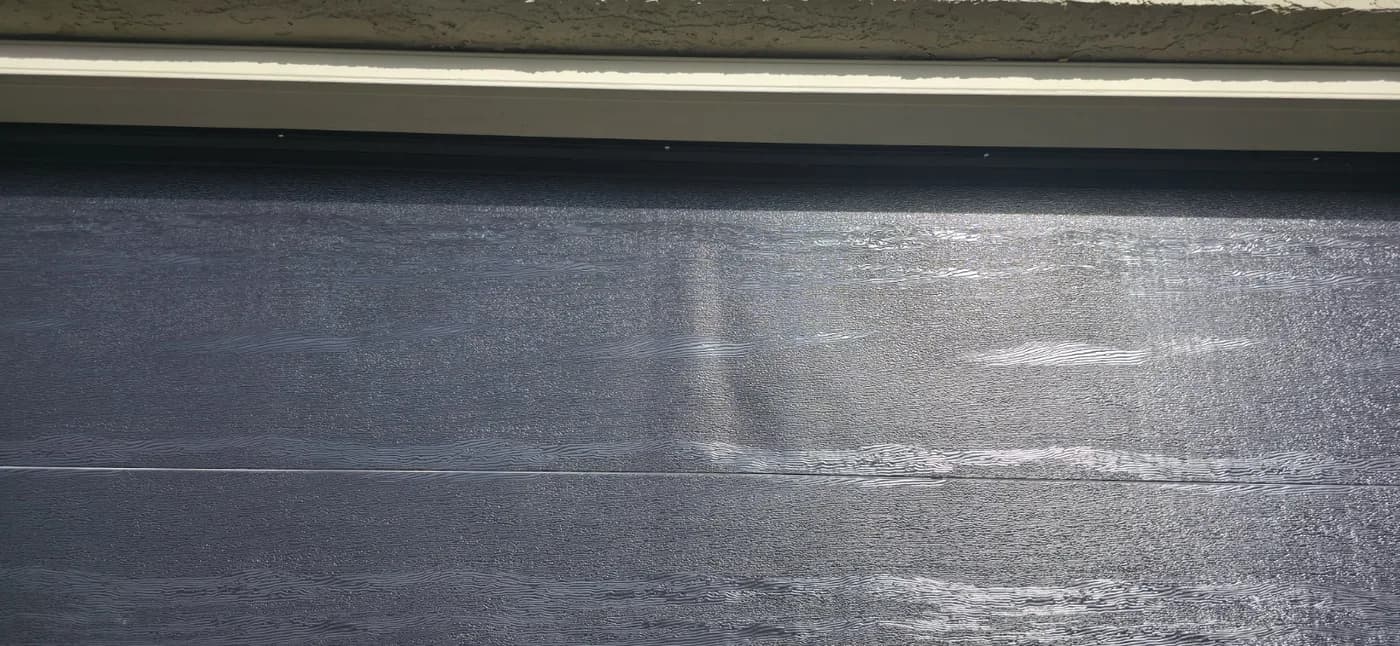
What You're Looking At
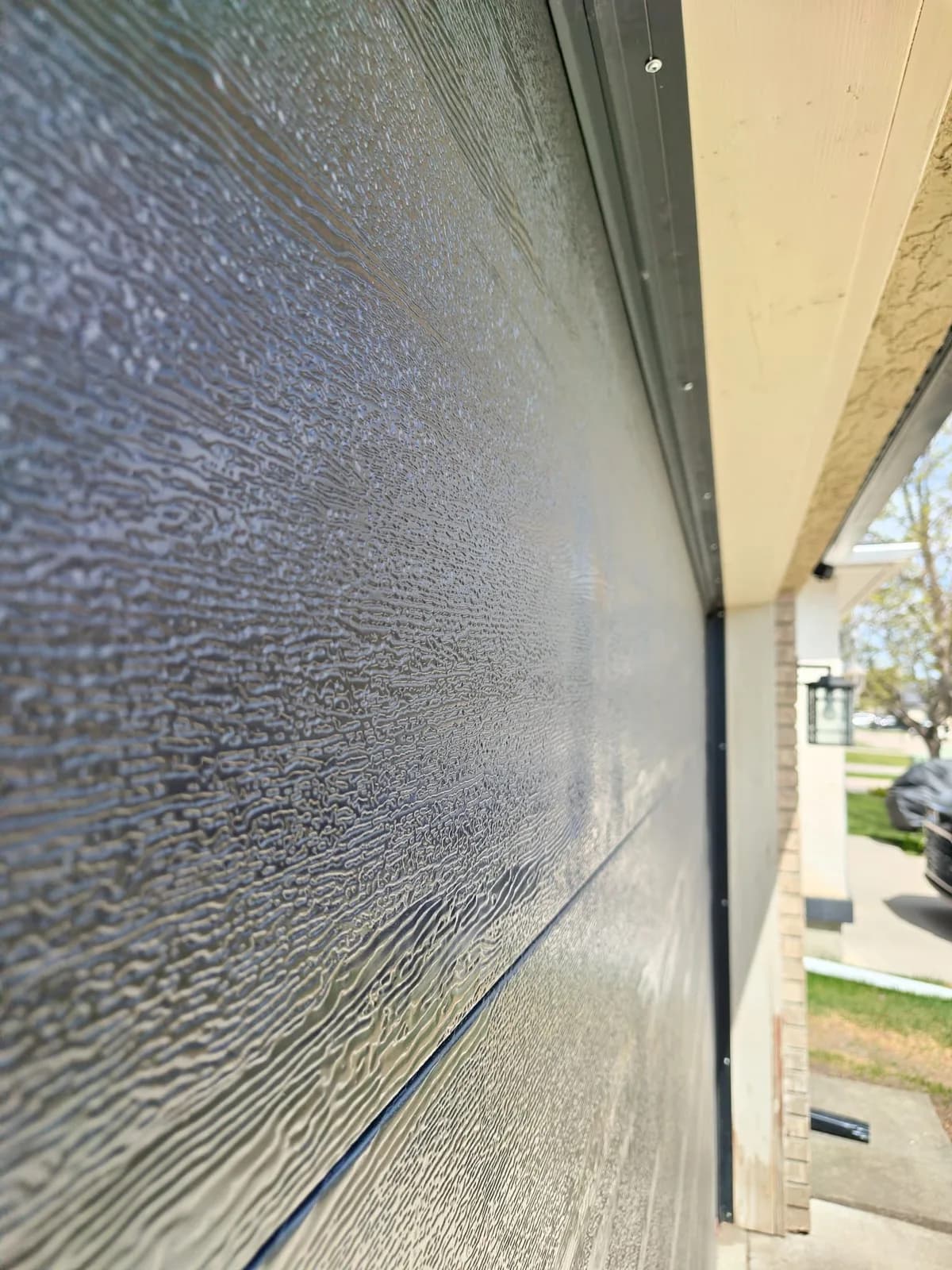
The wavy, distorted surface in those photos isn't peeling paint or a finish defect. It's the steel skin of the panel deforming because the polyurethane foam underneath is pushing outward. The wood-grain texture you see is the original embossed pattern — but it's been stretched and warped by foam expansion that the steel skin can't contain.
In garage door manufacturing, an insulated sectional panel is built as a sandwich:
- Outer steel skin (exterior, painted)
- Polyurethane foam core (the insulation)
- Inner steel skin (interior, often white or matching exterior)
The two steel skins are bonded to the foam core under factory pressure. The whole assembly is supposed to behave as one structural unit — the steel resists deformation, the foam fills the cavity, the bond holds them together for the life of the door.
When that bond fails, or when the foam itself loses dimensional stability, you get exactly what those photos show. It's a different failure mode than the bottom seal degradation we routinely service in winter, but both are accelerated by Calgary's specific climate.
What's Actually Happening Inside the Panel
Three things drive panel surface distortion on dark-coloured insulated doors:
1. The polyurethane foam softens at high temperatures
Polyurethane foam isn't a single material — it's a chemistry, and the formulation matters. Older foam manufacturing processes used HCFC-141b as a blowing agent (the gas that creates the foam cells). HCFC-141b foam tends to have lower dimensional stability over time, particularly when subjected to repeated heat cycles. The Montreal Protocol restricted HCFC-141b in Canada because of its ozone-depletion potential, but its use in residential garage doors persisted longer than in most industries.
Newer freon-free foam processes use CO₂ or hydrocarbon blowing agents. These produce foam that's more dimensionally stable through the cure-and-age cycle. Ryterna's freon-free PU process produces foam more dimensionally stable over time. When a budget-tier foam softens above its softening point, it expands slightly. The steel skin has nowhere to go — so the surface bows outward in waves.
2. Dark-coloured doors get hot. Really hot.
A dark-coloured garage door panel facing south in Calgary sun reaches surface temperatures most homeowners don't realize. Direct measurement on a 28°C summer afternoon, on a black or anthracite panel facing south, routinely shows surface temperatures of 65°C to 75°C — and that's the exterior skin. Inside the foam, where the heat soak peaks late in the afternoon, the foam itself reaches temperatures within 5-10°C of the exterior skin.
That's well within the range where lower-grade polyurethane formulations begin to soften.
3. Calgary's Chinook cycling makes it worse
Most Canadian cities have a slow build-up to summer heat. Calgary doesn't. Calgary's defining climate feature is temperature swings — both seasonal and daily. A January Chinook can take a garage door from -25°C to +10°C in 8 hours. A July afternoon thunderstorm can drop surface temperatures from 70°C to 25°C in 30 minutes when a cold front rolls through.
That's a 50°C swing in less than an hour, on the same panel, in the same day.
Polyurethane foam handles steady temperatures fine. Repeated thermal cycling is what stresses the foam-to-skin bond and accelerates dimensional changes in the foam itself. Calgary's Chinook climate produces more thermal cycling than almost any other Canadian city — which is why we recommend annual maintenance on every Calgary door regardless of brand, but particularly on doors approaching year 5 of service life when thermal-stress symptoms typically begin to surface.
What you see
Waves, bubbles, or a stretched woodgrain texture on the panel face.
What is happening
Foam movement and bond stress are pushing through the steel skin.
What to check
Panel warranty wording, door age, exposure direction, and steel skin thickness.
What Makes Some Doors Resistant — And Some Doors Not
The construction details that determine whether a panel will bubble in Calgary heat are mostly invisible from the outside. They're documented in the manufacturer's technical specifications — if they publish them.
Here's what to look for when you're comparing residential garage doors:
Steel skin thickness
Ryterna manufactures their double-skin steel panels at 0.5mm per skin on embossed (Stucco / Woodgrain) panels and 0.7mm per skin on Slick (flat) panels. Both interior and exterior skins are the same thickness on each panel. That's roughly double the steel of most North American residential doors, which commonly use 0.27mm to 0.40mm skin material.
Why this matters for Calgary heat: thicker steel resists deformation when the foam underneath expands. A 0.7mm Slick panel will hold its dead-flat surface through years of summer heat soak. A 0.27mm panel won't. We document the full Ryterna construction depth on the residential garage doors page, including panel thickness options across the four available specs (30mm, 40mm, 60mm, 80mm).
Foam blowing agent and density
The freon-free CO₂ or hydrocarbon blowing agent process produces foam with better long-term dimensional stability than older HCFC-141b foam. Foam density also matters — denser foam has more structural integrity at the foam-to-skin bond line.
Most North American manufacturers don't publish foam density or blowing agent details on their residential brochures. Ryterna does, because the spec is part of their European compliance documentation. The Calgary Doors Hub has the full European EN engineering certification breakdown including the panel thermal performance specifications.
Factory-bonding methodology
The bond between foam and steel skin is created during the factory sandwich-construction process. The bond strength depends on:
- Pressure during the bonding stage (higher pressure = stronger bond)
- Cure time before the panel leaves the line
- Surface preparation of the steel skin (galvanized + primed = better adhesion than bare or single-coated steel)
European architectural-grade manufacturing standards specify higher bonding pressures and longer cure times than budget North American residential production lines. Again, this is invisible from the outside — it shows up 5-10 years later when one set of doors is bowing in summer heat and the other isn't.
Factory paint finish quality
Surface heat absorption depends on paint color (a non-negotiable design choice on dark doors) but also on paint reflectivity. Factory-applied RAL paint with proper primer has different thermal properties than aftermarket field-applied paint or single-coat budget finishes. Same RAL number, different long-term heat behaviour.
Ryterna's panels are factory-painted in any of 200+ RAL colours with multi-coat primer-and-finish processes. Most North American budget doors offer 6-10 standard colours and use lower-coat-count finish processes.
Construction spec that actually matters
The visible damage starts with invisible specs
Steel skin
0.5mm to 0.7mm beats thin residential skins
Thicker steel resists foam movement instead of showing every internal wave on the exterior face.
Foam chemistry
Freon-free PU holds shape better
Modern CO₂ or hydrocarbon blown foam is more stable through Calgary heat soak and winter temperature swings.
Warranty clue
Thermal exclusions tell you plenty
If the panel warranty excludes deformation or texture changes, it may be excluding the exact failure Calgary exposes.
Why Calgary Specifically Punishes Cheap Panel Construction
Calgary has three climate features that compound the panel-bubbling problem:
1. Chinook-driven thermal cycling. As covered above, Calgary cycles through temperature swings that other Canadian cities don't. Each cycle stresses the foam-to-skin bond. Compare this to other prairie cities: Edmonton's cold is more sustained (covered in our Edmonton blog on summer heat impact) and Saskatoon has the widest annual range — but Calgary's cycling is what's specifically punishing on a daily basis.
2. High summer UV exposure. Calgary sits at 1,045m elevation with relatively dry summer air, which means UV exposure on south-facing surfaces is genuinely higher than in cities at sea level. UV degrades paint binders over time, and a degraded surface absorbs more heat than a fresh one. The first time you notice your dark garage door starting to look matte or chalky, you're seeing the start of the same thermal vulnerability that causes panel bubbling.
3. Strong south- and west-facing solar exposure. Calgary's prevailing weather patterns mean afternoon sun on south- and west-facing garages is intense from May through September. Front-drive homes in Mount Royal, Elbow Park, Britannia, Bayview, and most of Calgary's premium inner-city neighbourhoods have south- or west-facing garages by design — exactly the orientation that maximizes summer heat soak.
If your Calgary home has a dark-coloured front-drive garage facing south or west, the door spec matters more than it would in a sheltered north-facing detached garage.
What to Look For When You're Buying a New Garage Door in Calgary
Three questions to ask any garage door company quoting an insulated panel door for your Calgary home:
1. "What's the steel skin thickness on each side of the panel?"
A defensible answer is a specific number in millimetres. "Heavy-gauge steel" and "premium construction" aren't answers. The published spec on a quality residential door is 0.5mm or thicker per skin. If they can't tell you, the spec is probably below 0.5mm. We publish transparent pricing on every service we offer specifically because we believe the spec details should be visible before purchase, not after.
2. "What blowing agent does the foam use?"
If they don't know, that's information. Ask if they can find out from the manufacturer. The defensible answer is freon-free, with CO₂ or hydrocarbon blowing agents — this is the modern European compliance standard. Older HCFC-141b foam is increasingly rare on new residential doors but still present in some budget product lines.
3. "Show me the panel warranty terms in writing."
A panel warranty that excludes "thermal-related deformation" or "surface texture changes" is essentially excluding the most common Calgary panel failure mode. A panel warranty that covers rust-through and foam delamination for 10 years without thermal exclusions tells you the manufacturer believes their panel will hold up. That's the standard Ryterna warranty.
What to Do If Your Existing Calgary Door Is Already Showing Signs
If you're seeing wavy texture distortion on your current insulated garage door:
- Check if the door is still under panel warranty. Most North American residential panel warranties run 1-5 years from installation. Document the defect with photos and contact the manufacturer through your original installer.
- Don't try to flatten the panel by tightening hardware. Panel deformation is internal — the surface waves are a symptom, not a hardware adjustment issue. Tightening cables, springs, or track hardware won't fix it and may damage the panel further. If you're hearing unusual sounds from the door alongside the panel issue, that may indicate a separate problem with hinges and rollers or cable replacement — those need separate evaluation.
- Get a panel-only replacement quote if the warranty has expired. Single-panel replacement is usually possible on most door brands and saves the cost of a full door replacement when only one or two panels are affected.
- Consider whether a full door replacement makes sense long-term. If you're already 5+ years into the door's life and panels are starting to bubble in batches, the construction tier of the original door is the issue. Replacing one panel at a time will cost more over the next 5 years than upgrading to a properly specified door now.
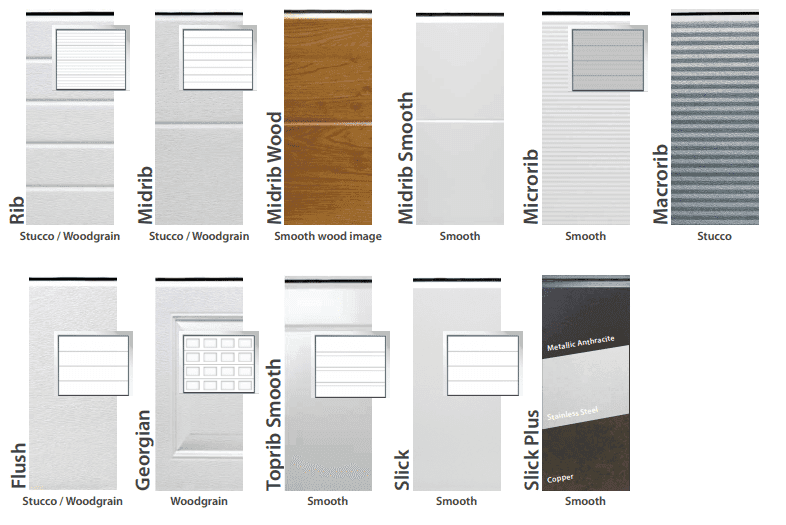
For Calgary specifically, if you're replacing a heat-distorted dark door, we'd recommend reviewing the residential garage door selection to compare options — particularly the Slick or Slick Plus profiles in Ryterna's design collections, which use 0.7mm steel skins specifically because the flat surface shows any deformation. The thicker skin is what keeps it dead-flat through Calgary summers.
If you're replacing the door and considering a coordinated exterior upgrade, Ryterna also manufactures matching entry doors and gates from the same Lithuanian factory with the same panel construction specs — same RAL colour, same finish across all four. For homeowners who want pedestrian access without opening the full door (relevant in Calgary winters as well as summer heat preservation), walk-through garage doors integrate factory-built into the same Ryterna sectional panel.
How Garage Door Fix Calgary Approaches This
We've seen panel-bubbling defects on doors from multiple budget-tier manufacturers across our 32,000+ completed jobs since 2019. We don't name specific brands in this article because the issue isn't one manufacturer's fault — it's a category-wide construction-tier problem affecting budget polyurethane foam doors in heat-cycling climates.
What we will say honestly: we used to install some of those doors ourselves. When customers wanted the lowest-priced insulated option, we'd quote what was available. We've now seen enough warranty claims to be selective about which budget-tier manufacturers we'll recommend for dark-coloured front-drive Calgary garages, and we'll tell customers honestly when a door spec is likely to develop heat-related issues over time.
For most Calgary homeowners shopping new doors, our standard recommendation pattern is:
- Detached unheated garages, light or white doors: Quality Northland or budget-tier Ryterna sectional. Spec-related issues are minimal at light colours.
- Attached heated garages, any colour: Ryterna entry-tier sectional or higher. The 0.5mm-skin panel construction with freon-free foam handles Calgary's thermal cycling without long-term deformation issues.
- South- or west-facing front-drive garages with dark colours (anthracite, black, dark grey): Ryterna Slick or Slick Plus with 0.7mm panels specifically. The thicker skin is what we recommend for the most thermally stressed Calgary installs.
This isn't because Ryterna is the only quality option in the world — it's because we're Canada's only authorized Ryterna dealer, which gives us the documented spec depth to confidently quote dark-colour Calgary installs without expecting warranty claims down the road. For homeowners with low-headroom or unusual layout constraints where overhead sectional doors don't fit, side-hinged garage doors use the same Ryterna 40mm panel construction in a swing-out format.
If you want to talk through your specific situation — measurement, recommendation, or pricing — we publish all our service rates and door pricing on our pricing page so you have the numbers before the conversation. Or contact us directly — Stan and Marta started Garage Door Fix in 2019 and we still take customer calls personally for door consultations.
Related Calgary resources