Most garage door problems we see in Edmonton happen in winter — frozen seals, snapped springs, opener failures at -38°C. But the failures we see in summer tell a different story, and they're the ones that catch homeowners off-guard because nobody warns them at the point of sale.
Specifically: panel surface distortion. Wavy textures appearing in the wood-grain or stucco finish on dark-coloured garage doors. Sometimes one panel, sometimes multiple. Usually showing up between years 4 and 7 of the door's service life, and almost always on south- or west-facing front-drive garages.
This isn't a weather problem the same way frozen springs are. It's a construction-tier problem — the door spec wasn't built for the cumulative summer heat exposure that Edmonton actually delivers. Here's what's happening, why Edmonton specifically punishes cheaper panel construction, and what to look for when you're choosing a new garage door that needs to last 20+ years.
Summer daylight
17-hour June exposure
Edmonton panels do not just get hot; they stay hot for hours because midsummer daylight keeps feeding the heat soak.
Failure timing
Usually visible around year 4 to 7
That is when weak foam chemistry, thin skins, and weaker factory bonding start showing as waves or bubbles.
Edmonton variable
Sustained heat after sustained cold
The same door has to survive deep winter contraction and long summer heat soak without the panel bond giving up.
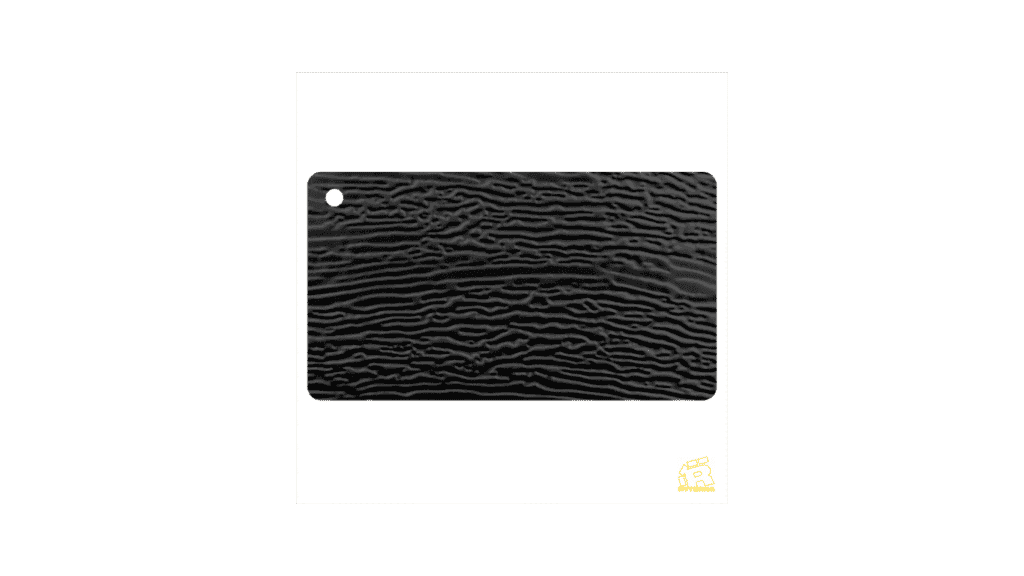
What's Visibly Wrong With the Panel
The wavy surface texture on a heat-distorted insulated garage door isn't paint failure or surface damage. It's the steel skin of the panel deforming because the foam underneath is pushing outward. The original wood-grain or stucco texture is still there — but it's been stretched into wave patterns that follow the foam's expansion lines.
In garage door manufacturing, an insulated sectional panel is built as a sandwich:
- Outer steel skin (exterior, painted)
- Polyurethane foam core (the insulation)
- Inner steel skin (interior, often white)
The two steel skins are bonded to the foam during the factory assembly process. The whole panel is supposed to behave as one structural unit through 20+ years of service. When the bond between foam and steel weakens, or when the foam itself loses dimensional stability under repeated heat exposure, the surface distortion you see in those photos is the result. It's a different failure mode than the bottom seal degradation we routinely service in winter, but both are accelerated by Edmonton's specific climate stresses.
Edmonton's Specific Climate Punishment
Edmonton's climate is famous for winter — sustained -30°C cold without Chinook relief, polar-vortex stretches at -38°C. What gets less attention is summer.
Edmonton sits at 53.5°N latitude. In June, the city gets 17 hours of daylight. That's longer summer days than Toronto, Montreal, or Vancouver. South- and west-facing garages in Edmonton's southwest growth corridor (Windermere, Cameron Heights, Magrath Heights, Keswick, Glenridding), the river-valley high-end neighbourhoods (Riverdale, Rossdale, Cloverdale), and inner-city renovation areas (Glenora, Westmount, Old Strathcona) sit in direct sunlight for 8-10 hours on a clear summer day.
Combined with summer afternoon temperatures that routinely reach 28-32°C in July and August, that produces a thermal exposure profile that's specifically punishing for cheap panel construction:
- Long sustained heat soak rather than short hot peaks
- Multiple consecutive hot days during the long-day-length season
- Limited overnight cooling during midsummer (overnight lows in July average 13-14°C — not enough cool-down time for the foam to fully recover before the next day's heat cycle)
A dark-coloured (black, anthracite, dark grey, dark brown) garage door panel facing south in Edmonton on a 30°C July afternoon reaches surface temperatures of 65°C to 75°C on the exterior skin. Inside the foam core, peak temperatures reach within 5-10°C of the exterior — and they stay there for 4-6 hours each afternoon, day after day, through the long Edmonton summer.
That's the regime where polyurethane foam quality starts to matter. Edmonton's pattern is meaningfully different from Calgary's Chinook-driven thermal cycling (covered in our Calgary blog) — Edmonton's failure mode is sustained heat soak, while Calgary's is rapid cycling stress. Both are punishing, both reveal construction-tier differences over 5+ years, but the mechanisms differ.
What's Actually Happening Inside the Panel
Three factors determine whether a panel will hold its shape through Edmonton summers or not:
1. The polyurethane foam blowing agent
Polyurethane foam isn't a single material. The blowing agent — the gas that creates the foam cells during manufacturing — determines a lot about the foam's long-term thermal behaviour.
Older foam manufacturing used HCFC-141b as a blowing agent. HCFC-141b foam tends to have less dimensional stability over time, particularly under repeated thermal cycling. The Montreal Protocol restricted HCFC-141b in Canada because of ozone depletion, but the transition in residential garage door manufacturing took years and some budget product lines were among the last to switch.
Newer freon-free foam uses CO₂ or hydrocarbon blowing agents. Ryterna's freon-free PU process produces foam that's more dimensionally stable through the cure-and-age cycle and through repeated thermal exposure. The full European EN engineering certification breakdown on Ryterna panels — wind class, water class, air permeability, thermal transmittance — is documented on the Edmonton Doors Hub for homeowners who want the technical detail.
When foam softens above its softening temperature, it expands slightly. Repeat that cycle 60-90 times across one Edmonton summer, year after year, and the cumulative dimensional change becomes visible as panel surface distortion.
2. Steel skin thickness
Ryterna manufactures their double-skin steel panels at 0.5mm per skin on embossed (Stucco / Woodgrain) panels and 0.7mm per skin on Slick (flat) panels. Both interior and exterior skins are the same thickness. That's roughly double the steel of most North American residential doors, which commonly use 0.27mm to 0.40mm skin material.
Why this matters in Edmonton specifically: thicker steel resists deformation when the foam expands. Even when the foam itself is good quality, a thin steel skin will telegraph any internal foam dimension change to the surface. A 0.27mm skin on a Slick (flat) panel design will show every minor foam imperfection. A 0.7mm skin on the same Slick design will hold dead-flat through 20+ summers. The full Ryterna panel construction depth across the four available thicknesses is documented on our residential garage doors page.
3. Factory bonding methodology
The bond between foam and steel skin is created during sandwich-construction at the factory. Bond strength depends on:
- Pressure during bonding (higher = stronger)
- Cure time before the panel leaves the line
- Steel surface preparation (galvanized + primed = better adhesion than bare or single-coated steel)
European architectural-grade manufacturing uses higher bonding pressures and longer cure times than budget North American residential production. This shows up not at year 0 but at year 5-7, when the bond integrity of cheaper construction starts to fail under cumulative thermal cycling.
Construction spec that actually matters
The visible damage starts with invisible specs
Steel skin
Thin skins show the problem first
A 0.27mm to 0.40mm skin telegraphs foam movement much faster than a 0.5mm or 0.7mm Ryterna panel.
Foam stability
Freon-free foam matters in year five
The difference is not obvious on install day. It shows up after repeated Edmonton summer heat cycles.
True cost
Cheap can become expensive
A cheaper door at $2,695 + GST can cost more long-term if panels need replacement before a Ryterna-tier door at $3,195 + GST reaches mid-life.
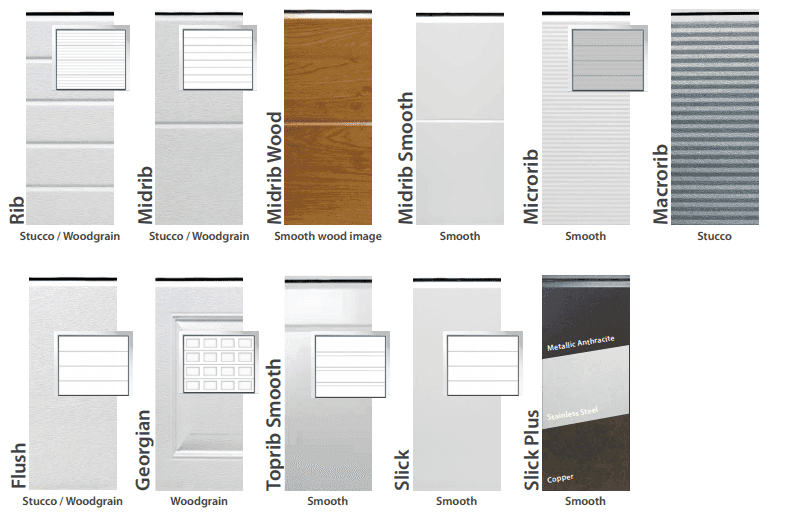
Construction Specs That Survive Edmonton
When we recommend doors for Edmonton homes — particularly south- or west-facing front-drive garages with dark colours — we anchor the recommendation to a few specific construction specs:
Steel skin thickness ≥ 0.5mm per skin
This is the single most reliable predictor of long-term panel surface integrity. Ryterna's 0.5mm/0.7mm spec is published in their technical documentation. Most North American budget doors don't publish skin thickness on their residential brochures because the spec isn't favourable.
For Edmonton specifically, on dark colours, we recommend a minimum of 0.5mm per skin and prefer 0.7mm on flat (Slick) profiles where any deformation will be most visible. Our transparent pricing page lists installed pricing across the Ryterna construction tiers so you can see the cost difference between budget construction and the spec we recommend for thermally exposed installs.
Freon-free polyurethane foam
The CO₂/hydrocarbon-blown foam process produces panels that hold their shape through repeated heat-cycling. This is now the European compliance standard and increasingly common on premium North American product lines, but still not universal on budget residential doors.
Multi-coat factory-applied finish
Surface heat absorption depends partly on the paint colour — a non-negotiable design choice — but also on the paint finish quality. Factory-applied RAL paint with proper primer and topcoat layers has different thermal absorption characteristics than aftermarket field-applied paint or single-coat budget finishes, even at the same colour code.
Ryterna's panels are factory-painted in 200+ RAL colours with multi-coat primer-and-finish processes. The paint isn't a separate decision from the panel construction; it's part of the same manufacturing pipeline.
10-year panel warranty without thermal exclusions
The warranty terms tell you what the manufacturer expects their panel to do. A panel warranty that covers rust-through and foam delamination for 10 years without exclusions for thermal-related deformation or surface texture changes is meaningfully different from a warranty that excludes the most common Edmonton failure mode. The 10-year panel warranty is the standard Ryterna factory warranty, no exclusions.
What Edmonton Homeowners Should Do Next
If you're shopping a new garage door for an Edmonton home, particularly if your home has a south- or west-facing front-drive garage and you want a dark colour:
1. Ask three specific questions
- "What's the steel skin thickness per side on this panel?" Defensible answer: a specific number in millimetres. "Heavy gauge" isn't an answer.
- "Is the foam freon-free?" Defensible answer: yes, with CO₂ or hydrocarbon blowing agent. Older HCFC-141b foam is increasingly rare on new doors but still present in some budget lines.
- "Show me the panel warranty in writing, with all exclusions clearly listed." A warranty that covers rust-through and foam delamination for 10 years without thermal exclusions is more comprehensive than one that limits coverage to manufacturing defects only.
2. Match the construction tier to the heat exposure
For Edmonton specifically, our standard recommendation pattern accounts for thermal exposure:
- North-facing garages, light or white doors: Most insulated residential doors will hold up well. Spec-related issues are minimal.
- Attached heated garages, light to medium colours, any orientation: Quality entry-tier insulated doors handle the thermal exposure. Mid-tier construction (0.5mm skins, freon-free foam) is sufficient.
- South- or west-facing front-drive garages, dark colours: This is where construction tier matters most. Recommend 0.7mm skins specifically on flat (Slick) profiles, freon-free foam, and a 10-year panel warranty without thermal exclusions.
- Heated workshops or home gyms, dark colours, any orientation: Same dark-colour recommendation as front-drive plus 60mm panel thickness for thermal performance.
3. Consider total cost of ownership, not just installation cost
A standard 16×7 insulated white door at $2,695 + GST is cheaper than a quality-tier Ryterna 16×7 door at $3,195 + GST. But if the budget door requires panel replacement at year 5 and full replacement at year 12, while the quality-tier door reaches year 25 without panel issues, the budget door costs significantly more over its actual service life.
Edmonton's specific summer thermal exposure is the climate factor that pushes this calculation hardest against budget construction. We service the Edmonton metro area and surrounding communities (Sherwood Park, St. Albert, Spruce Grove, Beaumont, Leduc, Stony Plain, Devon) for both repairs and new-door installations.
What to Do If Your Existing Edmonton Door Is Already Bubbling
If you're seeing surface waves on your current dark-coloured insulated door:
- Document the defect with photos and check your panel warranty. Most North American residential panel warranties run 1-5 years from installation; some go to 10 years for rust-through specifically. Contact the manufacturer through your original installer.
- Don't tighten hardware to flatten the panel. Panel deformation is internal — the surface waves are a foam-to-skin bond issue, not a hardware tension issue. Tightening cables, springs, or track hardware won't fix it. If the door is also showing balance or movement issues, the problem may need separate attention to hinges and rollers or cable replacement rather than panel work.
- Get a single-panel replacement quote if the warranty has expired and only one or two panels are affected. Single-panel replacement is usually possible on most door brands.
- Plan for full replacement if multiple panels show deformation. When 3+ panels on the same door start showing waves within 12-24 months of each other, the construction tier of the original door is the issue. Replacing one panel at a time will be more expensive over 5 years than upgrading to better construction now.
For Edmonton replacement consideration, our residential garage door selection compares Northland and Ryterna options. For dark-colour replacements specifically, Ryterna's design collections — particularly the Slick profile with 0.7mm skins — is our standard recommendation for thermally-exposed Edmonton orientations.
If you're replacing the door and considering a coordinated exterior, Ryterna also manufactures matching entry doors and gates from the same Lithuanian factory with the same panel construction specs. For homeowners wanting pedestrian access without opening the full door — relevant in Edmonton where opening at -38°C in winter or 30°C in summer both lose significant conditioned air — walk-through garage doors integrate factory-built into the same Ryterna sectional panel.
For garages with low-headroom or unusual layout constraints where overhead sectional doors don't fit cleanly, side-hinged garage doors and side-sliding garage doors use the same Ryterna 40mm panel construction in alternative formats.
How Garage Door Fix Edmonton Approaches This
We've serviced 32,000+ jobs across Calgary, Edmonton, and Saskatoon since 2019. We see panel-bubbling defects on doors from multiple budget-tier manufacturers — it isn't one company's problem, it's a category-wide construction-tier issue affecting budget polyurethane foam doors in heat-cycling climates.
Honest disclosure: we used to install some of those doors ourselves. When customers wanted the lowest-priced insulated option years ago, we'd quote what was available in the Edmonton market. We've now seen enough warranty claims to be selective about which budget-tier products we'll quote for thermally-exposed Edmonton installs, and we'll tell customers honestly when a door spec is likely to show issues over time.
Our standard pattern for Edmonton recommendations:
- Detached unheated garages, light colours: Quality Northland or budget-tier Ryterna sectional. Spec-related issues are minimal at light colours and lower thermal exposure.
- Attached heated garages, any colour, north or east facing: Ryterna entry-tier sectional or higher. Construction holds up across normal Edmonton thermal exposure.
- South- or west-facing front-drive garages, dark colours: Ryterna Slick or Slick Plus with 0.7mm panels specifically. Best long-term recommendation for the most thermally-exposed Edmonton installs.
Being Canada's only authorized Ryterna dealer gives us the documented spec depth to confidently quote dark-colour Edmonton installs without expecting heat-related warranty claims. That isn't a marketing claim — it's an operational consequence of installing thousands of Ryterna doors and tracking what we see at year 5, year 10, year 15.
If you want to talk through your specific situation, contact our Edmonton team — free consultation, measurement, recommendation, and honest assessment of whether your existing door warrants panel replacement vs full door replacement.
Related Edmonton resources