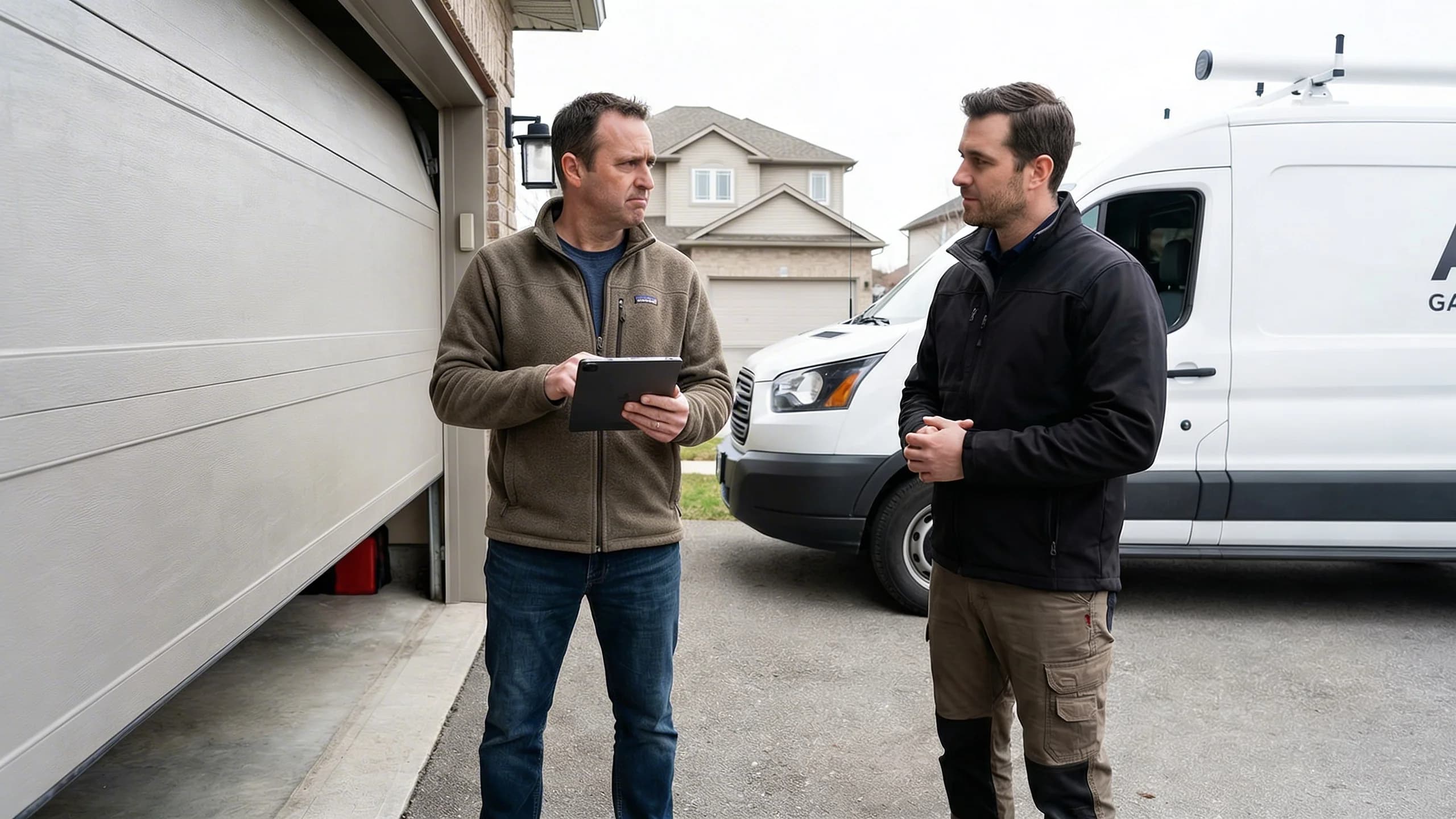
We founded Garage Door Fix in 2019, but I'd been in the garage door industry long before that. A lot of the horror stories stuck with me well before we opened our own company. The pattern is remarkably consistent: the quote sounded fair, the work got done, and the invoice was 30–50% higher than expected.
It's not always intentional deception. Sometimes it's just a business model that depends on fees the customer doesn't know about until it's too late. Either way, the result is the same — you pay more than you thought you would. Here are the three most common traps and how to avoid every one of them.
Trap #1: The Emergency / After-Hours Surcharge
How it works:
You call after 5 PM or on a weekend. The person on the phone quotes you a price that sounds reasonable. When the technician hands you the invoice, there's an extra line: "Emergency Service Fee" or "After-Hours Premium" — typically $75–$150.
Why it exists:
Most companies pay technicians overtime for evening and weekend shifts. That cost gets passed to you. Companies that use subcontractors for after-hours calls pay premiums to get someone to show up — and pass that through too.
How to spot it:
Ask one question: "Is the price the same if I book for 8 PM tonight vs. 10 AM tomorrow?" If the answer is anything other than an immediate, unqualified "yes" — expect a surcharge. Some companies call it different things (dispatch fee, priority service, weekend rate) to avoid saying "emergency fee."
What we do differently:
Our price is the same 24/7/365. A spring replacement at 11 PM on Christmas costs the same as 2 PM on a Tuesday. Our technicians do earn a bonus for after-hours work — but that comes out of our margin, not your bill. We'd rather make less on an evening call than pass the cost to someone who's already dealing with a broken door.
Trap #2: The Service Call / Diagnostic Fee
How it works:
You call for a repair. Before anyone touches your door, you're charged $50–$100 as a "service call fee" or "diagnostic fee" just for the technician showing up. Some companies credit this toward the repair if you proceed. Some don't. And some only tell you about it after the tech arrives.
Why it exists:
The service call fee is supposed to cover the technician's time and travel if you decide not to proceed with the repair. In practice, it's a commitment device — once you've already paid $80 just to have someone look at it, you're more likely to say yes to the repair at whatever price they quote.
How to spot it:
Ask: "Is there a fee just to have someone come out?" Also ask: "If I decide not to proceed, do I still owe anything?" Get both answers before they dispatch.
What we do differently:
No service call fee. No diagnostic fee. No charge to show up. We troubleshoot for free over the phone first, and if needed we'll ask for photos so we can narrow down the issue before we dispatch anyone. That helps us avoid idle travel for our technicians and helps you get a real number before a truck rolls. If we come out and you decide not to proceed, you owe us nothing. We confirm the price before dispatch — if you don't like the number, you don't book. Simple.
Trap #3: The Quote-Bait (Price That Changes on Arrival)
How it works:
You call, get a quote of $300 for springs. Sounds great. The technician arrives, looks at the door, and says: "Actually, your door is heavier than standard. The springs you need are $460." Or: "I noticed your cables are fraying too — I can do both for $650." The $300 repair just doubled. For the record — every reputable company will sometimes find additional issues on-site. The difference is how they handle it. We provide a complimentary inspection with every service, and if we spot something (like fraying cables), we photograph it, show you, and let you decide. We never replace parts without your approval or claim something was broken after the fact.
Why it exists:
There's an entire shadow industry of call centers operating fake Google Business profiles across every major city. The people answering the phone don't know garage door components, can't troubleshoot, and aren't trained to. Their job is one thing: dispatch a technician as fast as possible. If you ask about pricing, they follow a script designed to get the booking — not to give you an accurate number. The technician's job on-site is to sell. That's why the quote changes when they arrive: the phone price was never real. It was bait. Some legitimate companies also underquote because they don't bother asking the right questions — but the call-center operations do it deliberately and at scale.
How to spot it:
Ask: "Is this a final price or an estimate?" And: "What could cause the price to change after you see the door?" A reputable company will ask about your door size, insulation level, and spring type before quoting — because those details determine the price. If the person on the phone can't answer basic questions about your door or rushes to book without understanding the problem, that's a red flag. A company that quotes $300 without asking anything about your door is either guessing or baiting.
What we do differently:
We operate the opposite way. Our office team — real employees who know garage doors — will spend two or three phone calls with you if that's what it takes to understand the issue. They'll ask for photos of the door, the broken parts, the label. They'll walk you through what they're seeing. The goal is to get the quote right before we dispatch anyone. When we say springs are $380–$480, that's the price — because we already know what you need. The technician's job on-site is to fix your door, not to sell you things. If they find something unexpected, they call you before doing any additional work. The invoice never exceeds the confirmed price without your explicit approval.
What a "$300 Spring Replacement" Actually Costs
Let's run the math on a real scenario. You need a standard pair of torsion springs replaced on a Saturday evening.
Company A: "$300 Spring Repair"
Garage Door Fix: Published Price
Company A's "$300" repair costs $515. Our "more expensive" published price of $380–$480 saves you $35–$135. This is why comparing the advertised price — instead of the total price — is a trap.
How to Read a Garage Door Repair Quote Properly
Ask: "Is this the total price, including everything?" Not the base price — the total.
Ask: "Does this change if I book for evening/weekend?" Get it in writing or over a recorded call.
Ask: "Is there a fee if I decide not to proceed?" Service call fees are commitment traps.
Ask: "What could cause the price to increase after you see the door?" Honest companies will name specific scenarios. Dishonest ones will say "nothing" and then find something.
Check their website: Are prices published? If yes, the phone quote should match. If no prices are published, you have no reference point.
Compare totals, not base prices. A $460 all-inclusive repair is cheaper than a $300 + $215 in fees.
Why We Operate Differently
I started Garage Door Fix in 2019 because I was frustrated by the same industry I now compete in. The hidden fee model is profitable for companies, but it erodes trust. And trust is the only thing that generates 3,610+ five-star reviews.
Our model is simple: publish the price, confirm before dispatch, don't charge a penny more than quoted. No emergency fees, no service call fees, no travel fees. If that means our advertised price looks higher than a competitor's bait quote — so be it. The invoice tells the real story.

Stan and Marta Klugman
Founder & CEO, Garage Door Fix Inc.
Garage Door Fix has completed 32,000+ jobs since 2019.